
Cloud Computing and Hybrid Solutions
Introduction
In today’s digital era, cloud computing stands as one of the most significant technological shifts, enabling businesses and individuals to access powerful computing resources without the need to maintain costly infrastructure. It has redefined the way organizations manage data, applications, and services by providing on-demand scalability, improved collaboration, and cost efficiency. Alongside this transformation, hybrid solutions have emerged as a strategic model that combines the flexibility of cloud environments with the security and control of on-premises systems. Together, cloud computing and hybrid approaches empower organizations to innovate faster, remain agile, and stay competitive in the global market.
Understanding Cloud Computing
At its core, cloud computing is about delivering computing resources—such as servers, storage, databases, networking, and software—over the internet. Businesses no longer need to rely on expensive in-house servers that require constant maintenance. Instead, they can scale resources up or down based on demand, paying only for what they consume. This not only reduces capital expenditure but also ensures efficiency and reliability. Cloud platforms also enable remote access, making it easier for teams across different geographies to collaborate seamlessly. By abstracting complex infrastructure, cloud computing allows organizations to focus more on innovation and less on hardware management.
Hybrid Solutions Explained
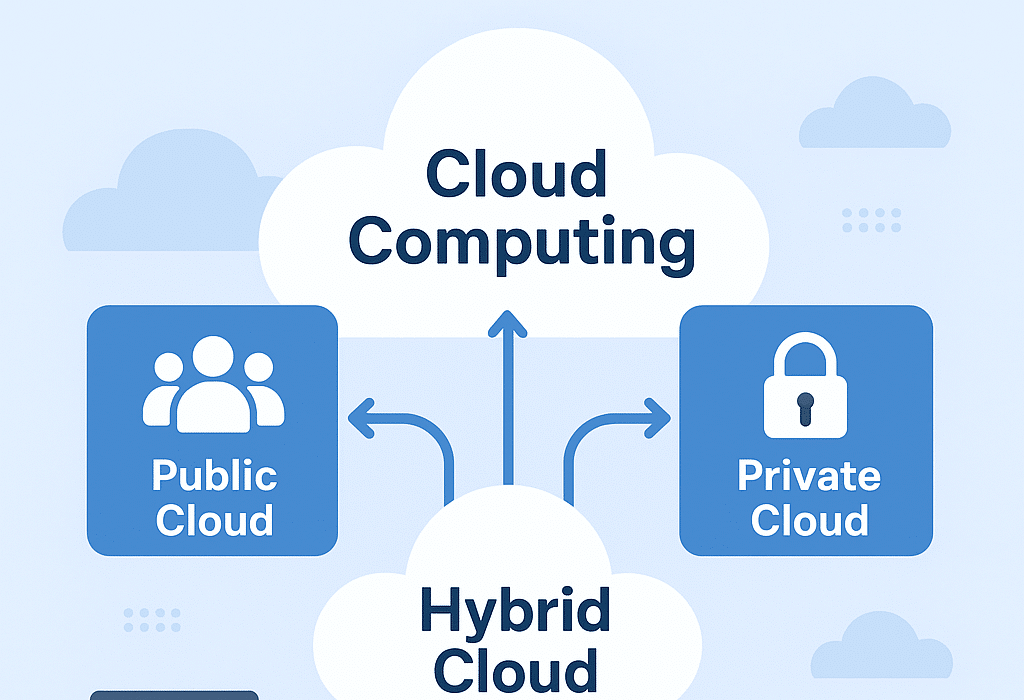
While the public cloud offers unparalleled scalability and flexibility, certain workloads cannot be moved outside an organization’s control due to compliance, privacy, or performance requirements. This is where hybrid cloud solutions come into play. A hybrid model integrates private infrastructure—whether on-premises or hosted privately—with public cloud resources. This approach enables businesses to run mission-critical and sensitive workloads securely in private environments, while leveraging the power of public cloud platforms for tasks such as data analytics, application hosting, or managing fluctuating workloads. Hybrid solutions act as a bridge, giving businesses the ability to move data and applications between environments with ease, providing both control and agility.
Applications and Benefits
The practical uses of cloud computing and hybrid models are vast and growing every day. In the financial sector, banks and insurance companies often keep confidential customer data on private servers to maintain security and compliance, while adopting public cloud resources to run mobile banking applications that handle millions of users. In healthcare, hybrid solutions ensure patient records remain private while enabling advanced data analytics to improve diagnosis and treatment plans. For e-commerce businesses, hybrid models allow websites to manage spikes in traffic during festive seasons by expanding into the public cloud, while securing payment systems in private infrastructure. Even manufacturing and logistics companies leverage hybrid approaches to analyze IoT data in real time, combining speed with secure storage.
The benefits of adopting cloud and hybrid solutions are numerous. Organizations gain scalability and elasticity, allowing them to adjust resources instantly to meet demand. Cost efficiency becomes achievable by paying for services on a consumption basis. Hybrid models also strengthen business continuity and disaster recovery by balancing workloads across multiple environments, ensuring services remain available even if one environment fails. Moreover, the blend of public and private systems supports compliance, improves performance, and enables businesses to innovate faster without compromising security.
Challenges and Considerations
Despite the advantages, there are challenges organizations must address when adopting cloud computing and hybrid solutions. Managing a hybrid environment can be complex, requiring specialized tools to ensure seamless integration and monitoring. Data migration between on-premises and cloud systems may introduce latency or security risks if not handled properly. Organizations also face compliance challenges when data crosses regional boundaries. Furthermore, security remains a top concern—while cloud providers offer robust security measures, misconfigurations or weak governance can expose vulnerabilities. Finally, cost management requires careful planning, as unchecked usage of cloud resources may lead to unexpected expenses.
Future of Cloud Computing and Hybrid Models
Looking ahead, the future of cloud computing lies in tighter integration with emerging technologies such as artificial intelligence, machine learning, and edge computing. Hybrid cloud models are expected to play a dominant role, providing organizations with the ability to process data closer to its source for faster insights while maintaining centralized security controls. Automation tools are making hybrid environments easier to manage, while multi-cloud strategies allow businesses to tap into the unique strengths of different providers. In the coming years, industries will increasingly rely on hybrid solutions not just as a bridge between on-premises and cloud, but as a foundation for innovation, resilience, and global scalability.
Conclusion
In conclusion, cloud computing has fundamentally transformed how organizations operate, offering scalable, cost-efficient, and accessible resources on demand. When combined with hybrid solutions, it creates a powerful strategy that balances the flexibility of the cloud with the security and control of private infrastructure. From healthcare and finance to retail and manufacturing, businesses across industries are reaping the rewards of hybrid adoption. Though challenges such as complexity and compliance remain, the continued evolution of cloud computing and hybrid models promises to redefine the digital future, ensuring that organizations are well-prepared for the demands of a rapidly changing technological landscape.
